
Bear Lake County Deed Types
Deeds in Bear Lake County are recorded by the Clerk, whose office files land transactions, mortgages, liens, judgments, and related instruments. Each deed names the parties and states the interest it transfers. That recording reference becomes a link in the chain of title. Still, the label alone settles nothing. The full text of the instrument controls its legal effect, so a document called one thing may work differently on close reading.
| Deed Type | What It Does | Common Use |
|---|---|---|
| Warranty deed | Conveys the stated interest with written promises | Conventional sale |
| Quitclaim deed | Conveys whatever interest the grantor holds | Family or title cleanup transfer |
| Trustee or representative deed | Conveys under trust or estate authority | Trust or probate transfer |
| Tax deed | Conveys the estate identified after tax proceedings | Delinquent-tax process |
| Reconveyance | Records a released deed-of-trust interest | Loan payoff trail |
Not everything recorded is a deed. A mortgage, deed of trust, lien, judgment, or reconveyance may sit in the same Bear Lake County records, yet these instruments burden or release an interest rather than pass title to a new owner. When a purchase, estate matter, easement, or unpaid debt raises a title question, search the whole instrument set at the recorder, not just the deeds.
Bear Lake Recorder Access
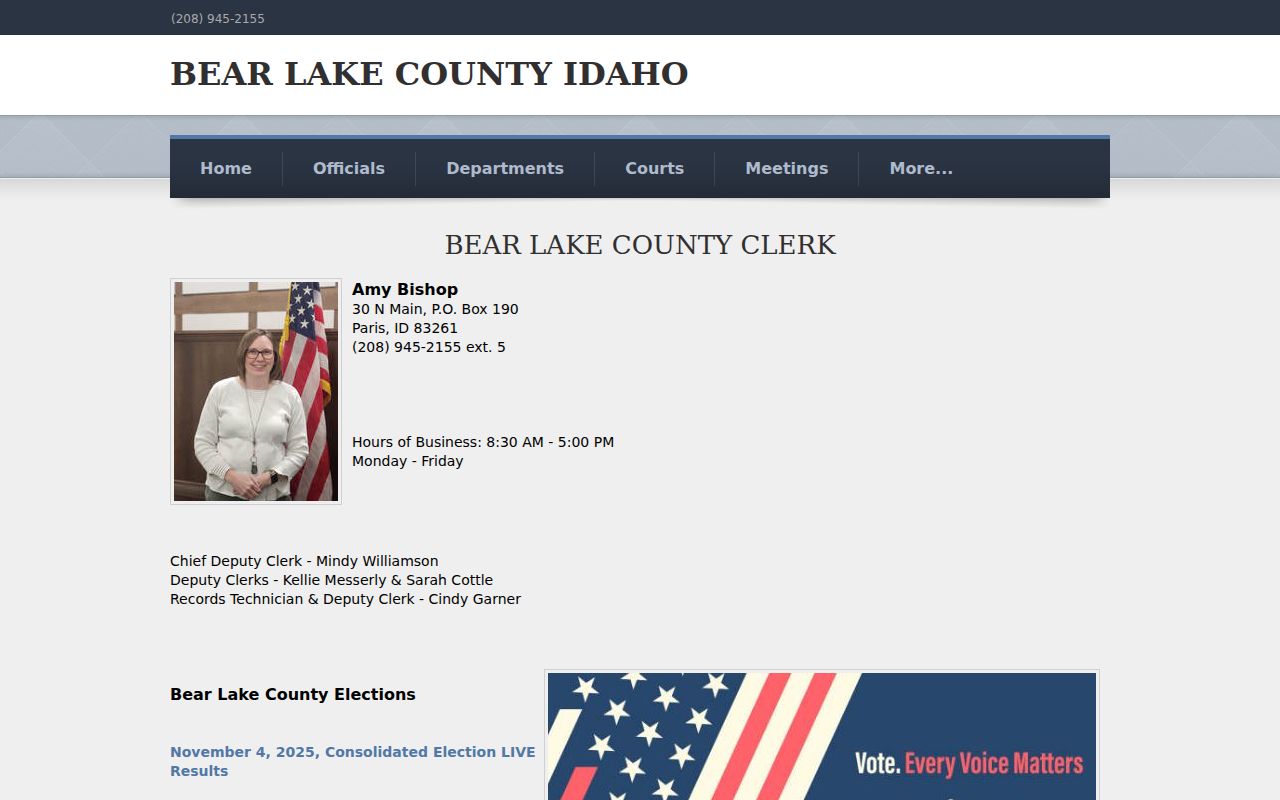
The county publishes no online grantor-grantee index or deed-image portal, so a deed search runs through the Bear Lake County Clerk by phone, mail, or counter visit. Gather your parcel keys first. Amy Bishop serves as Clerk at 30 N Main, P.O. Box 190, Paris, Idaho 83261, reachable at (208) 945-2155 ext. 5. Office hours run Monday through Friday, 8:30 a.m. to 5 p.m. The official Clerk page posts the county's recorder access point and its published services.
A parcel clue only gets you to the door. From there, a Bear Lake County deed search becomes a direct conversation with Clerk staff. Give them the PIN or AIN, the legal description, the current owner, likely prior party names, a date range, and any instrument number pulled from the parcel layer. Ask which counter or internal index covers your period. Bear in mind that a missing web result proves nothing. The county has never stated whether a public terminal, staff-only index, or legacy book system handles a given year of deed records.
Online gap. Bear Lake County publishes no deed-index coverage date, so the Clerk remains the source for index and image availability.
Parcel References Lead to Deeds
The Bear Lake County Parcel Map carries fields labeled Deed1 through Deed5 and InstrumentNumber. These are discovery tools, not deed images. Treat them as pointers. They help the Clerk locate a document, but they open no official recorded page and never replace the recorder index.
Copy every reference exactly, keeping punctuation and leading zeros intact.
Before requesting a deed, match the clue against the legal description and owner fields. A split parcel may point back to a parent tract. Mailing addresses change over time, while the legal land description remains the stronger bridge. Ask staff whether the cited instrument is truly the newest conveyance. The county publishes no map-refresh schedule for its parcel layer.
Walk Bear Lake's Deed Chain
Frame any Bear Lake County deed records search as a Clerk request. Build it on party, time, and land keys. Start with the newest confirmed deed on the parcel. The grantee receives the stated interest; the grantor gives it up. Then work backward, treating each prior grantor as a former grantee. Hunt for the instrument through which that party first acquired the land from someone else.
- Ask the Clerk for the latest deed using the owner, parcel keys, land description, and any instrument reference.
- Read the grantor, grantee, dates, deed type, and land description from the full document.
- Use the grantor as the likely grantee in an earlier acquisition, checking spelling and entity variants.
- Repeat while the description matches; follow parent tracts and plats when the parcel changed.
- For older years, continue through deed books and record each volume, page, and image status.
- Grantor
- The party that conveys the stated interest.
- Grantee
- The party that receives the stated interest.
- Chain of title
- The linked sequence of instruments affecting the same land.
- Book and page
- A volume-and-page location for an older filing.
- Instrument number
- A recorder reference that can lead staff to a filing.
Historic Bear Lake Deed Books
For old deeds, the FamilySearch Bear Lake land-record catalog lists digitized deed volumes starting in 1876. Overlapping books run through 1919. Bear Lake County is named as the original custodian. Some images sit behind an account or affiliated-center access. A catalog entry never guarantees that every deed of the period survived in the set. Bear Lake County was carved from Oneida County in 1875. Anything earlier may live in predecessor-county or territorial records. For each image you use, record the volume, page, DGS number, names, date, and legal description. Newspapers from the 1880s onward, University of Idaho microfilm, and Idaho State Historical Society holdings can add name and place clues. None of them replaces the Clerk's own record. No courthouse fire or destroyed-record account is on file. Hard-to-reach volumes online are not proof of loss.
Bear Lake Plats and Surveys
Surveys and subdivision plats also live with the recorder. They matter when a deed describes land by lot and block, subdivision name, or section-township-range terms instead of a street address. Many older Bear Lake County deeds use this style. The Clerk requires one Mylar and one paper copy of each survey. Both must be 18 by 27 inches. Recording runs $5 per survey, and copies run $4 per page. Subdivision plats need two 18-by-27-inch Mylar copies, paid before recording. A plat connects a deed lot to a mapped parcel. But it is not a fresh survey of the ground line. Parcel splits and annexations can change current IDs. A new PIN can break your chain. When that happens, follow the parent description back through the older deed books.
Mineral Deeds Need Care
Mineral rights caused a real mix-up in Bear Lake County. The commissioners' October 2025 minutes describe a Treasurer tax-deed sale. It offered what sits in the ground rather than surface land. Some interested bidders misread the estate being sold. A deed's name alone never tells what it conveyed. Read the granting clause and the legal estate. Compare any reservation, exception, mineral deed, or tax description. Remember that a surface parcel polygon can hide severed subsurface interests. Ask the Clerk and Treasurer to identify the exact instruments behind any sale notice.
Bear Lake Deed Fees
The Clerk's deed recording fee is $15. A mortgage or deed of trust runs $45 for the first 30 pages, then $3 for each added page. Reconveyances cost $15. Powers of attorney are $25, and other letter- or legal-size documents run $10 for the first page plus $3 per added page. Plain copies sell for $1 per page. These are recording and copy charges only, not a promise about any unlisted search or certification service. Describe the document you want. Request a fee estimate first, and note that Idaho residents may use the public-record route when an offline index or image is not otherwise available.
Bear Lake Legal Descriptions
A solid deed request follows the land itself. A street name alone will not do. Descriptions in Bear Lake County may use a subdivision, lot and block, acreage, or section-township-range terms. Copy the complete description from the parcel record, then compare it against each recorded instrument word for word. The current PIN can change after a split. A parent-tract description often links to the earlier deed. City and ZIP labels shift too. Neither change moves the county recorder who actually holds the title record.
Platted property needs the recorded plat too. Paris has a historic block grid. Georgetown records preserve names like Geo-Town, Stringtown Replat, and Curtis Subdivision, while Montpelier parcels can carry North Park lot-and-block descriptions. These names work as search keys. When a modern address fails, give the Clerk the subdivision and lot, any former street name, and the instrument reference. Georgetown's Becky Lane to Horseshoe Lane change proves it. An old address can break a modern search even when the resolution, plat, parcel, and recorder instrument form a clear crosswalk.
For acreage, compare the deed language with the legal acres and the total acres on the assessment record; neither number relocates a corner. Recorded surveys, plats, and a licensed surveyor settle the boundary questions a deed index or GIS line cannot.
Estate Transfers in Bear Lake
Death or a trust can pause a clean chain. A buyer-to-seller sequence stops when an owner dies or property passes into trust handling. Search for deeds executed by a personal representative, trustee, estate, or heirs, then use Idaho iCourt as a case lead for a Bear Lake probate. The portal offers case-shell access. Actual documents may require the courthouse kiosk or a request to the local clerk. ICAR 32 governs sealed and exempt court material.
Bear Lake County holds birth and death records for 1907 through 1911. Later vital records sit with Idaho Vital Records. Those certificates carry confidentiality and eligibility rules. They do not prove title. They may explain why a probate party or deed uses an estate name. The title step is still the recorded instrument. Match the probate authority, exact decedent or trust name, land description, and recording reference before adding the transfer to a chain.
Court guidance says most record requests take three working days, with notice within ten if more time is needed. Staff do not compile a new data set. Ask for a named case or document, and if the parcel map still shows the deceased owner, ask the Assessor about update timing because Bear Lake publishes no closing-to-roll lag.
Liens Alongside Bear Lake Deeds
The Clerk's duties reach beyond deeds. They cover mortgages, liens, judgments, and land transactions. A deed search that stops at ownership can miss an encumbrance or release. Ask for deeds of trust, assignments, reconveyances, recorded judgments, and lien releases tied to the same parties and land. A reconveyance shows a released deed-of-trust interest. A judgment may still need a court-file check.
Idaho SOSBiz UCC records can add entity or fixture context when the owner is a business. A UCC result does not prove land ownership. Match the entity name from the deed or Owner1/Owner2. Then return to county instruments. Likewise, iCourt can reveal a foreclosure, quiet-title, partition, or boundary case shell, yet the case result never substitutes for the recorded deed or release.
Build a dated checklist of every instrument. Include the recording reference, parties, document type, land description, and whether the image was actually reviewed. This keeps a lead from becoming proof. For a purchase or a disputed interest, a title professional should evaluate the complete record rather than relying on a self-built list.
Request Bear Lake Deed Copies
A deed records request to Bear Lake County can go three ways. You can go in person, by mail, or after a phone call. Be specific about what you want. Say whether you need to view an entry, get a plain copy, or hold a certified copy. Include exact names, the PIN or AIN, and the legal description. Add an instrument or book/page reference and a tight date range.
Routine channels sometimes fall short. When that happens, a written request under Idaho Public Records Law, Title 74, Chapter 1, can name the records you need. It can also state how you want them delivered. The Attorney General's guidance notes that exemptions may apply. Charges can vary with labor, page count, residency, and record type. A well-built request asks for records that already exist. Staff are not obliged to build a title analysis for you.
Say up front whether electronic delivery works for you. Ask the office to pause if costs look set to climb past the estimate. Keep the response, the receipt, and any certification together. Note which facts came from a recorder copy. Track which came from the assessment map, and which came only from a catalog. That source trail pays off later. Names, parcel numbers, and legal descriptions sometimes shift over time, and knowing where each detail originated settles disputes fast. If the Clerk surfaces several possible instruments, sort them out with the land description and recording date. Don't trust a shared surname to mark the right transfer. For a certified result, follow the office's current request and payment instructions.
Recorded, not guaranteed. A deed copy shows a filed instrument; it is not a title opinion and cannot rule out every unrecorded interest.