
Trace Former Bear Lake County Property Owners
A backward chain starts with the newest grantee you can trust. That deed's grantor becomes the next former owner to chase. Because Bear Lake County publishes no online grantor-grantee index or public image cutoff, you will join current parcel clues with Clerk requests and historic deed books rather than a single web search.
| Source | Years It Covers | Where Held | What It Shows |
|---|---|---|---|
| Newest deed | Current era | County Clerk | Grantor, grantee, date, description |
| Deed books | 1876-1919 catalog run | Clerk originals / FamilySearch | Earlier conveyances and reverse indexes |
| Recorded plats | As created | County Clerk | Parent tract, lots, blocks and streets |
| Newspapers | Title-dependent | Local archive / microfilm | Leads for sales, estates and name variants |
Begin with the PIN, AIN, legal description, and any deed reference shown in the county parcel layer. When the chain runs older than what the office index route covers, move to the deed books themselves.
Work Around Bear Lake County's Online Deed Gap
The county offers no official public deed-image search or online cutoff. That gap pushes the work back to the Clerk. It is reachable at 30 N Main, PO Box 190, Paris, or (208) 945-2155 ext. 5. Bring names, a date range, parcel identifiers, and the legal description. Counter, mail, and phone access are the main road here, not a backup. The official Bear Lake County Clerk page is where that offline chain begins.
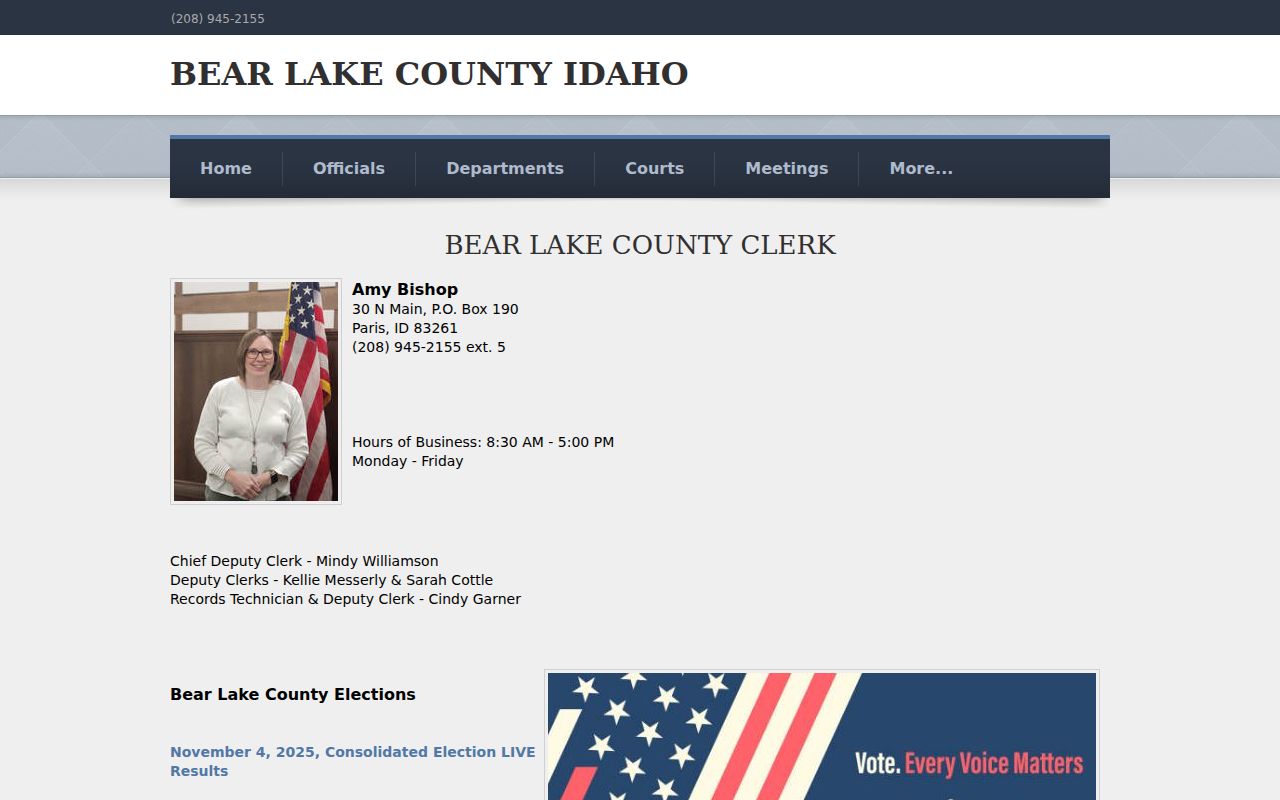
The Clerk's page lays out the recorder route for deed requests. Each former owner still has to match the same legal description. It has to match in the deeds you receive. If a request stalls, a narrow written ask under the Idaho Public Records Law remains a fallback. No web index does not mean no deed exists.
Reconstruct the Bear Lake County Deed Chain Backward
Every link in the chain must match both a name and the land. A former owner may have held several parcels. One parcel may also have been split or replatted. Record the legal description and the recording reference at each transfer so the sequence stays honest.
- Find the current grantee's acquisition deed for the exact parcel.
- Read the grantor, deed type, date, recording key, and legal description.
- Search that grantor as an earlier grantee, allowing name variants but requiring a land match.
- Repeat through reverse indexes and deed books, following parent tracts and plats.
- Grantor / grantee
- The party conveying an interest / the party receiving it.
- Chain of title
- The linked sequence of conveyances for the same land.
- Reverse index
- An index organized by grantee for tracing acquisitions.
- Warranty / quitclaim
- Different deed forms whose text, not label alone, controls the recorded claim.
Follow Bear Lake County Parent Tracts and Plats
When a description shifts from acreage or PLSS calls to lot and block, pull the recorded plat. Several plats fill that role here. North Park, the Paris townsite, Geo-Town, Stringtown Road Replat, and Curtis Subdivision all act as local bridges between eras of Bear Lake County records. Street names can shift under you. Georgetown renamed Becky Lane as Horseshoe Lane in Curtis Subdivision. Resolution 2006-1 cites Plat #T6386-4200 and instrument #193887. Test both street names while holding the plat and parcel identity constant.
Use Bear Lake Newspapers as Ownership Leads
The local newspaper archive can surface sale notices, estates, subdivisions, and name variants. University of Idaho microfilm holdings offer the same kind of leads. They narrow the hunt. They do not convey title. Always return to the deed and the exact tract. Do that before adding a person to the chain. Note: Keep a source date beside every former owner. An historic lead is then never presented as current.
Recognize Breaks in a Bear Lake County Owner Chain
A tidy run of warranty deeds is only one possible history. Probate can put a personal representative or heir in the record instead of a buyer. A sheriff deed may follow a court process. A tax deed can convey a limited estate rather than the surface parcel. Bear Lake County commissioners' October 2025 material shows the danger plainly: bidders misunderstood a tax-deed sale that covered mineral rights in the ground. Always ask what estate or interest the instrument actually conveyed.
Mortgages, liens, judgments, and reconveyances belong in the wider title trail. They do not automatically add former owners. Keep encumbrances in a separate event column. That habit keeps a lender, lien claimant, or judgment creditor from slipping into the grantor-to-grantee sequence as though it had owned the land.
Carry Bear Lake County Land into Predecessor Records
County formation draws an archival boundary, not a break in the land. Bear Lake County dates to 1875. The deed-book catalog begins in 1876. For anything earlier, carry the physical description, survey references, and names into Oneida County. The same material can also be carried into other predecessor context. Never force the modern county or a modern street onto an instrument created under older geography.
Historic town names work the same way. A source may say Twin Creeks. It may also use an older townsite label that no longer matches the mailing city. Treat the historic term as a search key. Then map it to the current parcel through the plat, section-township-range, or metes-and-bounds language. That is slower than swapping addresses, but it protects the real continuity of the land.
Keep a research log. Log the exact indexed name, record date, deed type, book and page or instrument number, and the matching land description for every former owner. The log exposes gaps early and keeps an archive lead from quietly becoming a claimed transfer.
Navigate Bear Lake County's 1876-1919 Deed Books
The FamilySearch catalog offers the clearest map of the historic run. It lists digitized Bear Lake County deed volumes covering 1876 through 1919, and it credits the County Clerk with the originals. Start in the index volume matching the transaction period. Note the film or volume reference. Then open the cited deed page. A catalog entry does not guarantee that every image displays freely on every device or account, so plan accordingly.
Where both exist, read the direct and reverse indexes. The direct index follows the grantor. The reverse follows the grantee. Spellings, initials, married names, and entity suffixes drift over the decades, so test reasonable variants while insisting that the legal description agree each time. Treat the index as a pointer only. The deed page itself supplies the parties, the operative language, the recording facts, and the tract description that let you keep walking backward through the property records.
Make the Bear Lake County Legal Description the Constant
Street numbers are convenient but fragile across a long chain. A lot-and-block description can outlive a street renaming. Section-township-range calls can pin down acreage that never carried a situs address at all. At every deed, transcribe the description or enough distinctive calls to prove continuity. If the wording shifts, suspect a plat, replat, survey, split, or correction. Confirm which occurred before treating the new description as equivalent.
The current Tax_Parcel layer helps here. It exposes PIN, AIN, acreage, LegalDesc, and limited deed references. Use those as starting clues rather than substitutes for the older instruments. When a parent tract divided, log the split in your timeline. Follow only the child parcel holding the subject land. That discipline keeps adjacent lots with one former owner of record from collapsing into a false chain.
Bridge Bear Lake County Probate and Estate Transfers
A deceased owner's name can vanish from the next deed without any conventional sale. Check Idaho iCourt for the Bear Lake County case shell. Ask the local Clerk for the actual probate documents when the file matters. The case may name a personal representative, heirs, or an order affecting authority to convey. Whatever the outcome, the eventual recorded deed or decree must still be matched to the parcel. It must still be matched.
Treat iCourt as an access lead, not a promise that every document image sits online. Courthouse kiosk or clerk access may be required for the full record. Vital records follow separate eligibility and confidentiality rules. They cannot substitute for the property and court trail. Keep the probate event in the chain only to explain authority and timing. Then return to the recorded land document itself.
Request Older Bear Lake County Records Precisely
For an offline deed-book or plat request, gather the essentials first. Include the former owner's indexed name, the approximate year, the deed type if known, a book/page or instrument clue, the current PIN or AIN, and the legal description. If the tract once carried an older town or road name, supply both versions. Precision matters most where the county publishes no public online index to its deed records.
Idaho's public-record process remains available when a clearly identified record is not supplied through ordinary office service. State guidance asks for requester and contact details, residency information, the records and date range, and a delivery choice. Ask for the existing record. Do not ask the custodian to run an open-ended genealogy project or produce a title opinion.
See How Far Back Bear Lake County Ownership Records Go
The FamilySearch Bear Lake land catalog lists deed books from 1876 through 1919 and names the County Clerk as keeper of the originals. The county formed in 1875, so earlier land may require Oneida County or predecessor-jurisdiction context.
No published web cutoff. Older former owners may require deed books or microfilm. Never invent an online start year where the county states none.
A probate filing can break an otherwise simple chain of title in Bear Lake County. So can a tax deed, a sheriff deed, or the split of a parent tract. Track down that event first. Do not assume a sale is missing. Former owner research in the property records supports house history. It also supports estate work and lawful property diligence. It must never be used to stalk or harass a living person.