
Bear Lake County Tax Fields
Bear Lake County property tax records start in two places: the Assessor's parcel layer and the Treasurer's account. The public layer holds working values, the last assessment, any relief, bill numbers, and amounts. Collection belongs to the Treasurer, who keeps the rolls and the payment history that settles what is owed.
| Field | What It Shows | Where |
|---|---|---|
LastAsmValue | Last assessment value in the parcel layer | Assessor parcel record |
WorkValue_Land and WorkValue_Impv | Land and improvement work values | Assessor parcel record |
HOExemptValue | Homeowner exemption value shown for that parcel | Assessor parcel record |
CurTxBillNum and CurTxBilled | Current account and billed amount fields | Parcel layer, then Treasurer |
CurTxOwed and TotTxOwed | Current and total owed fields requiring confirmation | Parcel layer, then Treasurer |
Bear Lake County assessments begin with what a willing buyer would likely pay on January 1, since Idaho assessors value property at full market value minus any exemptions that apply. Keep in mind the tax roll reflects an estimate, not a transaction. A parcel number can show a last-sale figure of zero or a date years old. Meanwhile, its assessment fields carry the current numbers the tax bill actually draws from.
Search Bear Lake Tax by PIN
Start with the county parcel map to pull the PIN or AIN. Next, open the Treasurer's eNotices portal. Copy the number exactly. The county warns that all PINs may be needed. One wrong digit can fail the lookup.
Treat the portal as an entry point for an electronic notice or a payment. It is not a full tax-history index. Check the account against CurTxBillNum. CurTxOwed may read zero. TotTxOwed may not. In that case, call the Treasurer instead of guessing which year or charge produced the balance.
The Bear Lake eNotices screen displays the electronic notice and the payment entry.
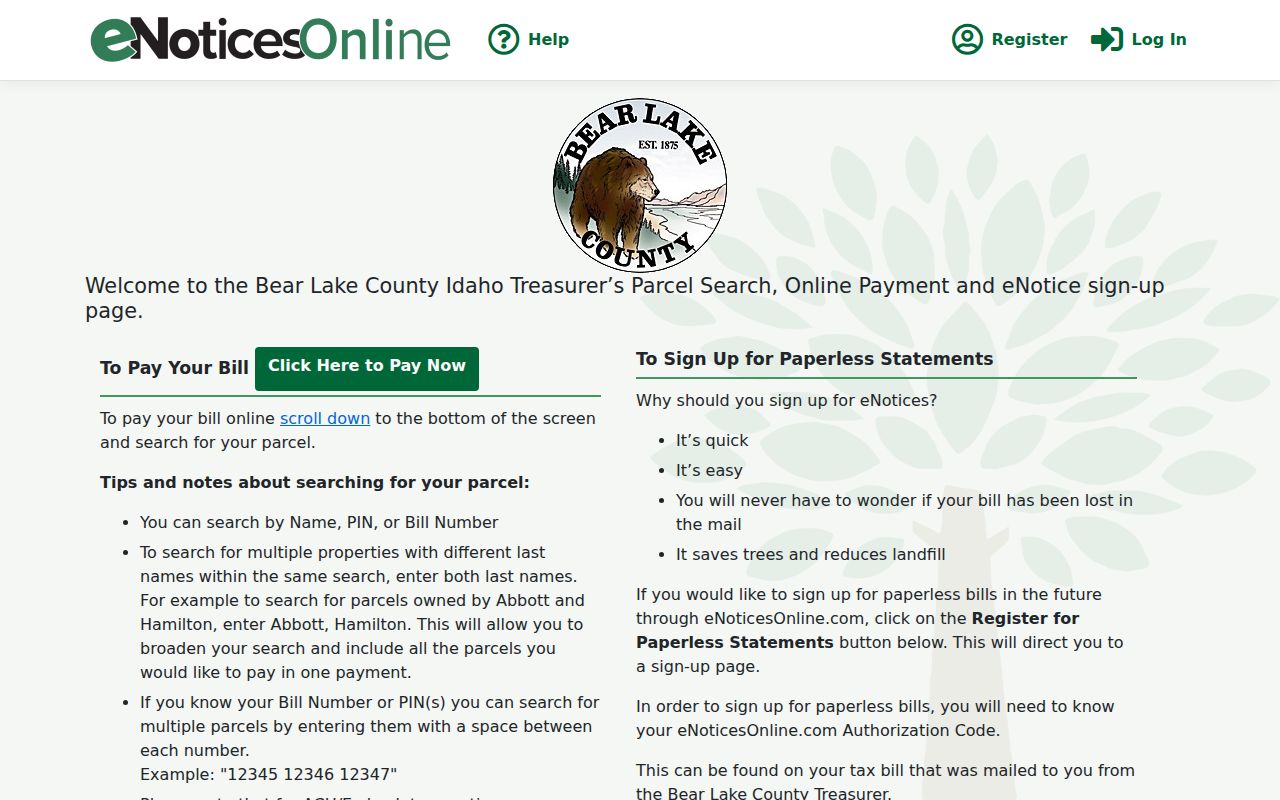
The screen underscores the same point: confirm the PIN and the account before paying. Fees apply, too. The Treasurer charges 2.19 percent for card payments and two dollars for an e-check. A tax field on the parcel layer is not a receipt. So settle any doubt before you submit money.
Bear Lake Assessment Details
An Assessor record splits value into land, improvements, and a total working figure. It also carries prior-year fields, property class, acreage, legal description, neighborhood, and sale data. Those details show what was valued and how the current record differs from an earlier one. They do not open up the full appraisal work file. The Bear Lake County Assessor sits at 30 N Main, Box 190, Paris, Idaho 83261, and answers at (208) 945-2155 ext. 4. The office handles mapping and links agricultural eligibility, homeowner relief, circuit-breaker information, and Board of Equalization forms. If the map and the mailed assessment notice disagree, ask for a parcel-specific explanation. The county publishes no parcel-layer refresh schedule. When a tax question turns on timing, note the date and the fields you viewed.
Look Up a Bear Lake Bill
A reliable Bear Lake County property tax search keeps three steps apart: identity, assessment, and payment. One address can return several results, especially where mailing and situs addresses differ. The PIN is what binds the map record to the tax account.
- Find the parcel in the map by address, owner, PIN, or AIN and verify its legal description.
- Enter the correct PIN in eNotices and compare the bill number and amount with parcel fields.
- Review
HOExemptValueand relief with the Assessor, not just the payment screen. - Ask the Treasurer for payment history, delinquency, or tax-deed details not shown online.
- Assessed value
- The assessor's value before an applicable exemption is subtracted.
- Levy
- The combined taxing-district rate used in the tax calculation.
- Homeowner exemption
- Relief for an eligible home and up to one acre under current Idaho rules.
- Tax lien
- A legal claim tied to unpaid property tax.
Bear Lake's Tax Calendar
The Treasurer mails annual notices by the fourth Monday in November. Pay the full amount or the first half by December 20. This avoids late charges and interest. For existing homes, the notice describes a six-month grace period. The second half is due June 20 of the next year. Supplemental or occupancy tax falls due February 20. Relief applications open January 1 and close April 15 under the county calendar. The fourth Monday in June is the deadline to appeal an assessment. For the tax year at issue, follow the current Treasurer instructions.
Bear Lake Property Tax Relief
Idaho's homeowner exemption covers 50 percent of an eligible home and up to one acre. The cap comes from a statutory maximum and current-year rules. The state also offers tax reduction, deferral, and veterans benefits. Caps and eligibility shift over time. One parcel's exemption value is never a promise for the next. File with the Bear Lake County Assessor between January 1 and April 15 as published. Ask what proof the office needs. Remember that relief on a parcel is a record for that parcel and year only.
County Values Rose in 2025
The Idaho Tax Commission's 2025 final comparison put Bear Lake County value at $222,042,374. That was up from $191,238,537 in 2024. That is an increase of $30,803,837, or 16.108 percent. The figure is countywide context, not the change for any one city or parcel. An appeal has to stand on the subject record and fitting evidence. Its assessment, physical traits, maps, photographs, calculations, and appraisal material matter far more than applying the county percentage to a single tract.
Tax Deeds May Mean Minerals
October 2025 county minutes describe a tax-deed sale of mineral rights, and some interested bidders reportedly thought land parcels were at stake. Read any Bear Lake County property tax notice for the estate it actually names. Surface ownership and minerals do not always move together. Get the current notice and its description from the Treasurer. Then confirm the resulting deed and any reservations with the Clerk. A GIS polygon shows surface geography only. It cannot settle a mineral estate.
Read Bear Lake Tax Amounts
The public parcel layer carries both CurTxOwed and TotTxOwed. The two are not identical. One points to a current amount. The other can reflect a broader total. The same layer also includes CurTxBilled, CurTxBillNum, and CurPTR. These fields help locate the account. But the Treasurer's record controls whether a payment posted and what remains due.
Before calling, write down the PIN, bill number, tax year, amount, and date viewed. If eNotices is thin or the values conflict, ask for a payment history. The Treasurer sits at 30 N Main, P.O. Box 55, Paris, Idaho 83261, (208) 945-2155 ext. 7. A chief deputy contact is also published at (208) 945-2130 ext. 1406. Office hours run Monday through Friday, 8:30 a.m. to 5 p.m.
A mailed notice, an online amount, and a GIS field can each be snapshots. Each may come from a different point in the process. None counts as a certified receipt unless the Treasurer supplies that record. The distinction matters most near installment dates. It also matters right after a payment. The same is true when a parcel carries more than one PIN.
New Construction Tax Notices
Existing homes get their tax notice each year by the fourth Monday of November. Payment splits into two installments. New construction is different. The county says recent improvements receive at least two notices, so a single bill or parcel screen can look odd. Compare the assessed improvement field, all notices, and the tax year before calling an amount missing or duplicated.
The GIS parcel layer splits value into three fields. Look for WorkValue_Land, WorkValue_Impv, and WorkValue_Total. Those working values help frame a question for the Assessor, but the official notice and the office's own explanation control the actual assessment. Building permit records show when work was approved, though they do not set taxable value. County and city permit files fill out the assessment timeline.
For construction inside Montpelier, Paris, or Georgetown, check the city land-use route along with the county permit material. Jurisdiction follows city boundaries and annexations. The mailing ZIP does not decide it. Ask the Assessor which improvements were counted in the assessment year. Ask which effective dates applied too.
Request Bear Lake Tax History
eNotices is not a full historic tax index. Older bills, certified payment histories, delinquency runs, and tax-deed files live with the Treasurer. Request those directly. Give the PIN or AIN. Include the bill number if known, plus the owner as indexed. Add the legal description, the exact years, and your preferred format. A narrow ask is easier to locate. It also costs less than a demand for everything tied to an address.
The Idaho Public Records Law is the fallback when routine access falls short. The state request model asks for the requester, residency, and contact information. It also wants a search description, from-and-to dates, examination or copies, and a signature. Idaho residents get two labor hours and 100 pages free under the Attorney General's summary. Extra labor, page, or attorney review costs can apply. So ask for an estimate.
No agency has to create a new calculation. Ask for what already exists: tax notices, ledger entries, payment records, delinquency notices, tax-deed documents. Exempt material can be withheld. A historic tax deed deserves a cross-check with the Clerk. Read the final recorded instrument closely. Check whether it conveyed surface land, minerals, or another defined interest.
Appeal Bear Lake Assessments
Start with the Assessor and the county Board of Equalization. The local deadline is the fourth Monday in June. Hearings run through the second Monday in July. Use the current form and submit parcel-focused proof such as maps, photographs, value calculations, or appraisal material.
A later appeal goes higher. Its instructions say you file with the county auditor and pay no fee. The deadline is generally 30 days from the decision. The current appeal page controls.
Organize the filing around the valuation date and the parcel's facts, noting land and improvement values separately and flagging any exemption. Maps can show location and access context, while photographs document condition. A professional appraisal or a clear value calculation gives the board a method to review. Explain why the county figure is disputed. Countywide percentage changes alone do not establish one parcel's market value, and a past sale may not reflect the January 1 condition behind the current assessment.
Keep proof of filing and the decision date. The next deadline runs from that decision. A Board of Tax Appeals ruling can affect the current year and later years under state guidance, though current instructions control. Bill questions stay with the Treasurer. Value and parcel questions stay with the Assessor. Holding that line keeps a payment problem from getting tangled up in a valuation appeal.
What if the deadline has passed? Contact the Assessor rather than assuming an informal chat preserves appeal rights. Ask which records can still be corrected and which issues must wait for the next cycle. Save the assessment notice, parcel-layer values, legal description, exemption data, photos, and any written office explanation for future review. A complete dated file makes the next Bear Lake County property tax review easier to support.
Appeal window. File by the fourth Monday in June under the county calendar, and verify the current form and tax year.